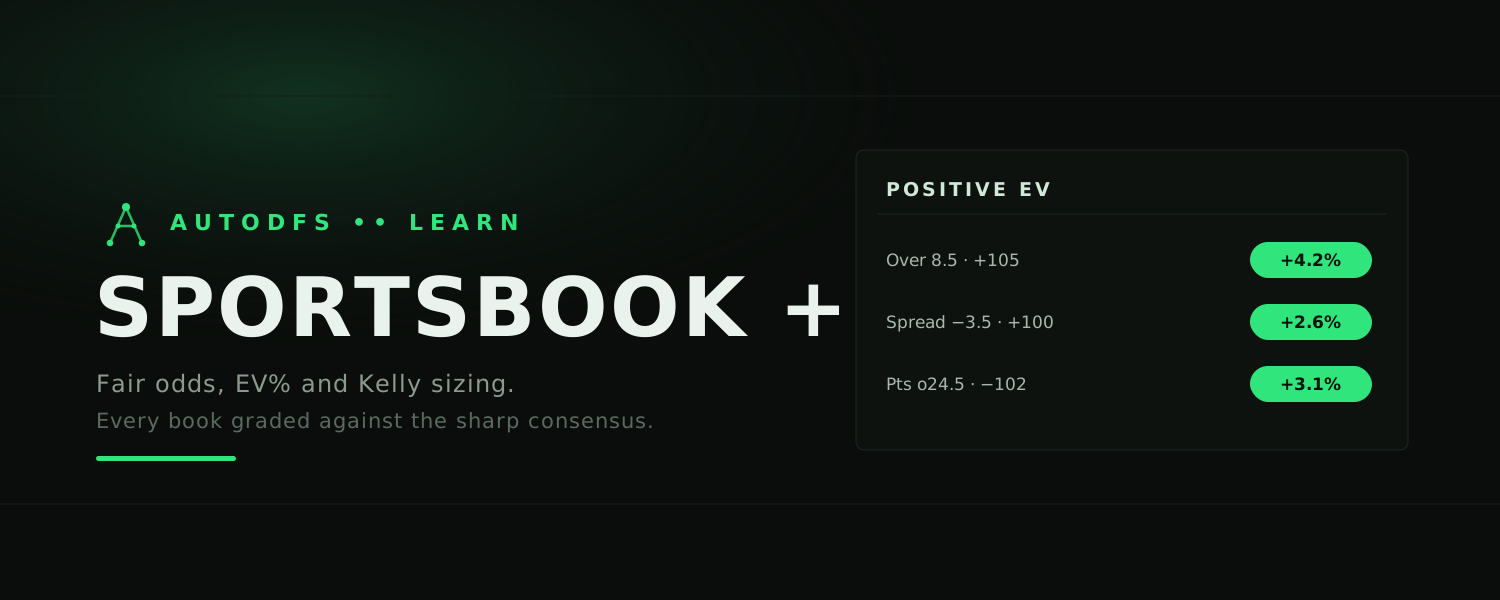
A sportsbook price is a probability with a margin baked in. Positive EV betting means only taking prices that pay more than the event's true chance — and with 20+ books pricing the same game, some of them always lag.
Step 1: find the fair price
Both sides of a market add up to more than 100% — that extra is the vig. Remove it and you have the book's fair probability. Do that across the sharpest books and exchanges, blend them, and you get a consensus fair line that is hard to beat. On the AutoDFS sportsbook board, every game line and player prop is graded against that number.
Step 2: compare every book to it
EV% = fair probability × decimal payout − 1. A side that is fair at 50% and pays +110 (2.10) is +5.0% EV. At −110 (1.909) it is −4.5%. The board does this for every book, every line, continuously. Edges under 2% show in orange (thin, often gone quickly); 2% and up show in green.
Step 3: size the bet
The Kelly criterion turns an edge into a stake: f = (b·p − q) / b, where p is the fair probability, q = 1 − p, and b the net odds. Full Kelly swings hard, so the board defaults to quarter Kelly and caps any suggestion at 25% of the bankroll. Set a bankroll and each play shows a dollar amount.
Step 4: only bet where you can
Hide the books you can't use in your state and the board re-ranks around the ones you can. Prediction-market and exchange prices are netted of their fees before the EV is computed, so they are compared on what they actually pay.
Why it works
Retail sportsbooks move slower than the sharp market, set lines independently, and shade popular sides. Each gap is small. Taken one at a time they are noise; taken every time, over hundreds of bets, they are the only edge that compounds. Track results by EV, not by wins — a +EV bet that loses was still the right bet.