Every pick'em entry is a price. When you take a player over 22.5 points at a fixed payout, the app is implicitly telling you how often it thinks that happens. Expected value (EV) is the gap between that implied price and the player's true probability — and it is the only number that predicts whether you make money over time.
The one number: EV%
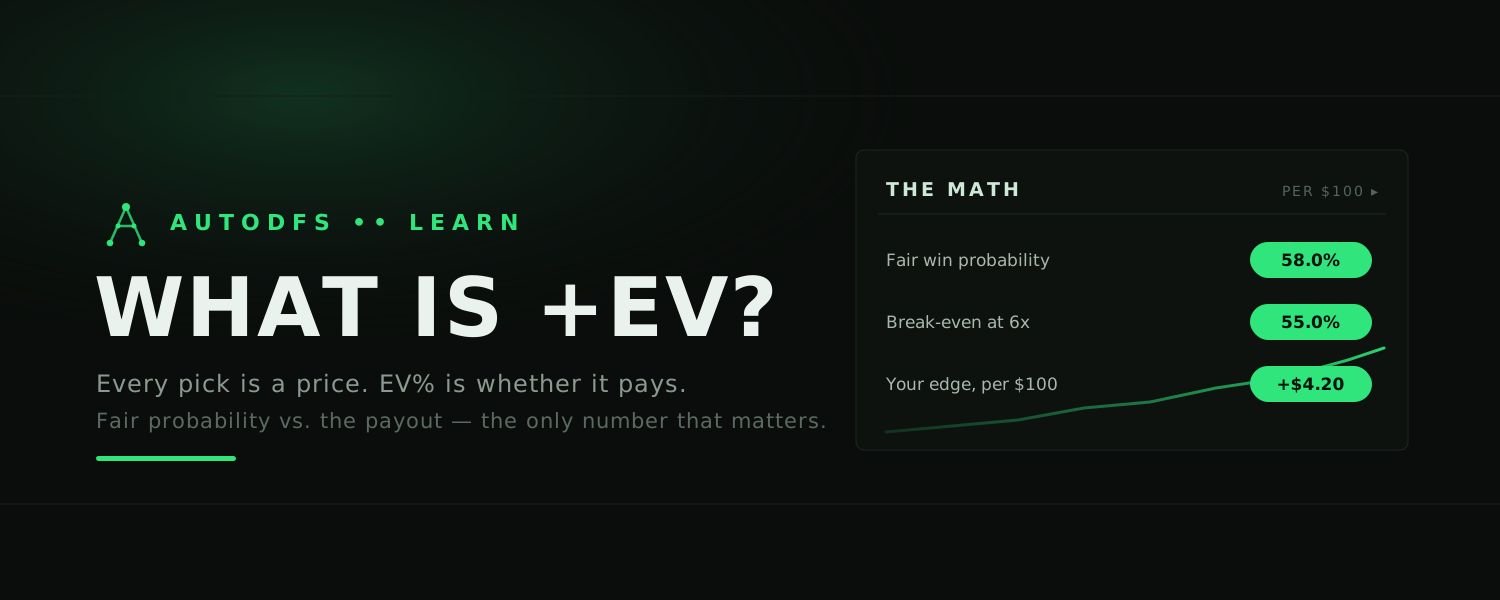
+4.2% EV means about $4.20 of expected profit per $100 played, before variance. −5% EV means the app keeps $5 of every $100 long-run — that is the house edge you pay when you pick on vibes. The sign matters more than anything else you will ever read about a pick.
Why mispriced lines exist
- Apps price independently. Each DFS app sets its own player lines. They move at different speeds, lag injury news differently, and shade different markets.
- The sharp market is the reference. Sportsbooks with high limits and sharp action converge on the most accurate probabilities. When an app's line disagrees with that consensus, the gap is measurable.
- Fixed payouts can't adjust per pick. A pick'em app pays the same multiplier whether your legs are 51% or 61% to hit. Finding the 61% legs is the entire game.
A concrete example
Suppose the sharp consensus prices a rebounds over at 58%. A 3-pick entry paying 6x needs each leg to hit about 55% to break even. Playing that leg is +EV: you are being paid as if it were a coin-flip-and-a-bit when it is measurably better. String three such legs together and the entry itself is +EV — the math compounds in your favor.
What AutoDFS does with this
AutoDFS computes a fair probability for every player line from 20+ sportsbooks in real time, compares it to each app's payout structure, and shows you the result as one ranked number: EV%. Green means the price is on your side. Everything else on the platform — the board, the generator, the research views — exists to surface that number faster.