Sportsbooks are better than DFS apps at guessing. AutoDFS uses them as the answer key.
A sportsbook takes very large bets. If their number is wrong, sharp bettors hammer it and the book loses money — so books fix wrong numbers fast. DFS apps do not face that pressure in the same way, and they have far more lines to look after.
So the sportsbook number is usually closer to the truth. AutoDFS uses that.
What happens for every line, every minute
- 1. Collect. Read the price for that same player and stat at about 20 sportsbooks.
- 2. Clean. Books build in a profit margin. That margin is removed, so what is left is an honest probability.
- 3. Blend. Combine them into one number — the fair %. This is how often the pick should really hit.
- 4. Compare. Hold the fair % against the bar from Lesson 2.
- 5. Sort. Put the biggest gaps at the top.
Reading the answer
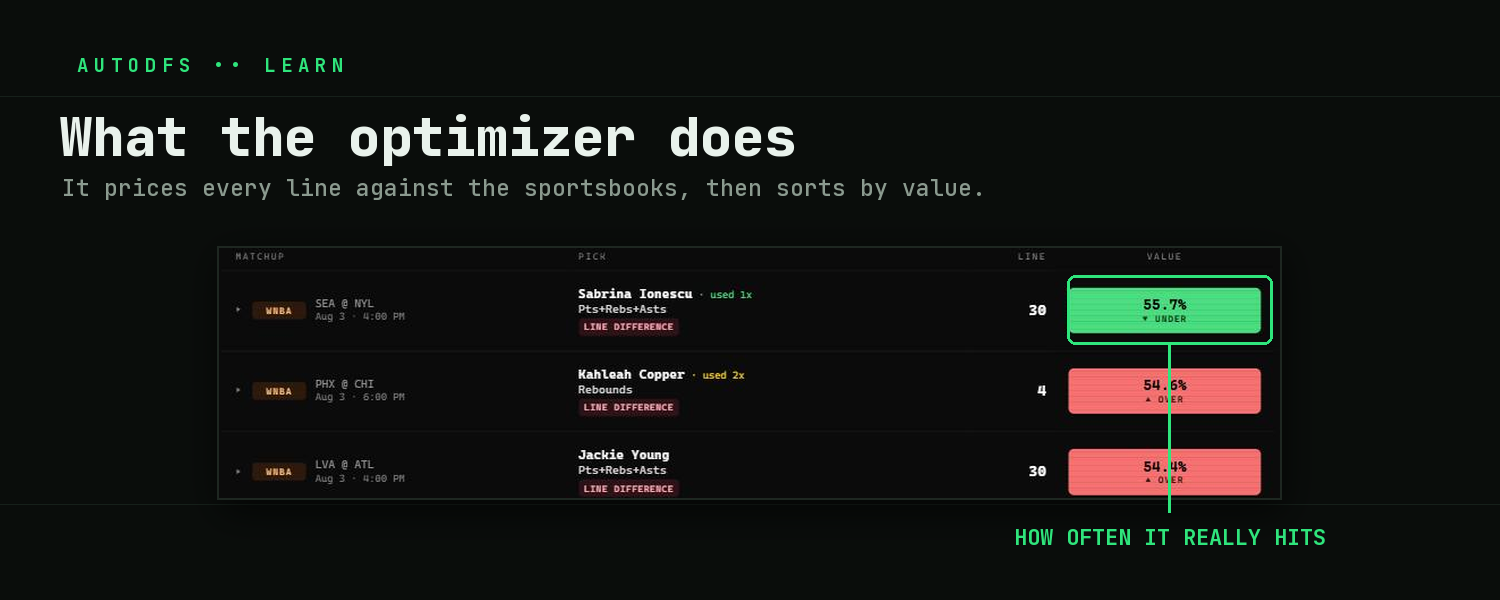
On the board, that fair % is the big number in the VALUE chip, and the color is the verdict:
- Green — the fair % is above the bar. Worth playing.
- Red — the fair % is below the bar. It loses money over time.
A green 55.7% on a 3-pick means the market thinks it hits 55.7% of the time, while you only need 55.03%. That gap is your edge. It is small, and it is supposed to be small — a real edge in a priced market is a couple of points, not double digits.
This is not a crystal ball. A 55.7% pick still loses 44.3% of the time. The edge only shows up across hundreds of picks, which is why the bankroll advice matters more than any single night.
Words you just learned
- Fair % — how often the pick should really hit, per the sportsbook market.
- Consensus — the blended opinion of many books, rather than one.
- EV% — expected value: roughly what you win or lose per $100 over the long run. Green is positive, red is negative.