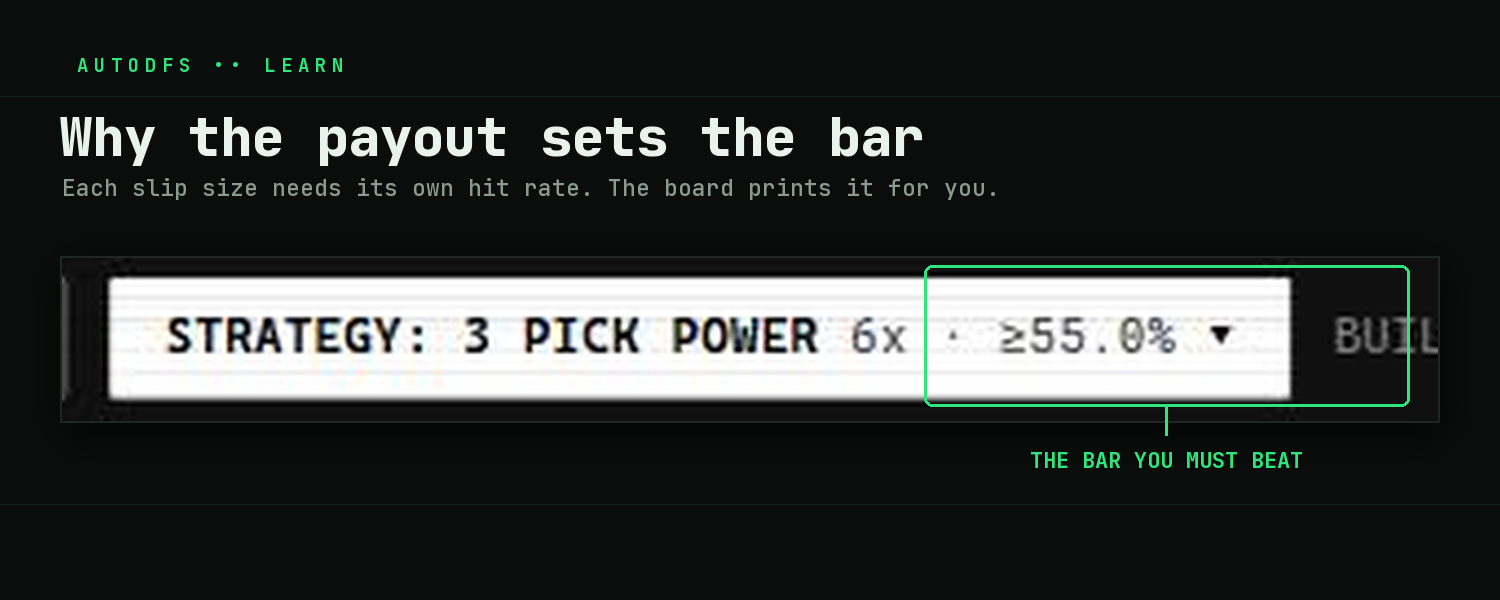
Being right half the time loses money. The payout decides how often you actually need to be right.
Say you take a 3-pick where all three have to hit and it pays 6x. Put in $10, get back $60 if all three land.
How often do all three land? Multiply:
- Three coin flips (50% each) → all three hit about 1 time in 8.
- But it only pays 6x. Winning 1 in 8 while getting paid 6 loses money.
So 50% is not the bar. Work backwards from the payout instead: you need all three to land 1 time in 6, because that is what 6x pays. The number that does that is 55.03% per leg. (0.5503 × 0.5503 × 0.5503 ≈ 1/6.)
The bar for every slip size
These are the real numbers, worked out from each app’s actual payout table:
| Slip | Pays | You need |
|---|---|---|
| 2-pick (Underdog) | 3.5x | 53.45% |
| 3-pick, all must hit | 6x | 55.03% |
| 5-pick flex | 10x / 2x / 0.4x | 54.25% |
| 6-pick flex | 25x / 2x / 0.4x | 54.21% |
| 6-pick, all must hit | 40x | 54.07% |
Why one bad leg is so expensive
Put two legs at the break-even 55.03% into a 3-pick and add one coin flip. The slip is now −9% EV. One lazy leg turned a break-even slip into a losing one. This is why the board hides legs under the bar unless you ask to see them.
Words you just learned
- Break-even — how often each leg must hit for you to end up even. Below it you lose over time; above it you win.
- Power / all-must-hit — every leg has to land or you get nothing.
- Flex — you still get paid something if you miss one (or sometimes two).
Next: how the board knows a line is above the bar before the game starts.